
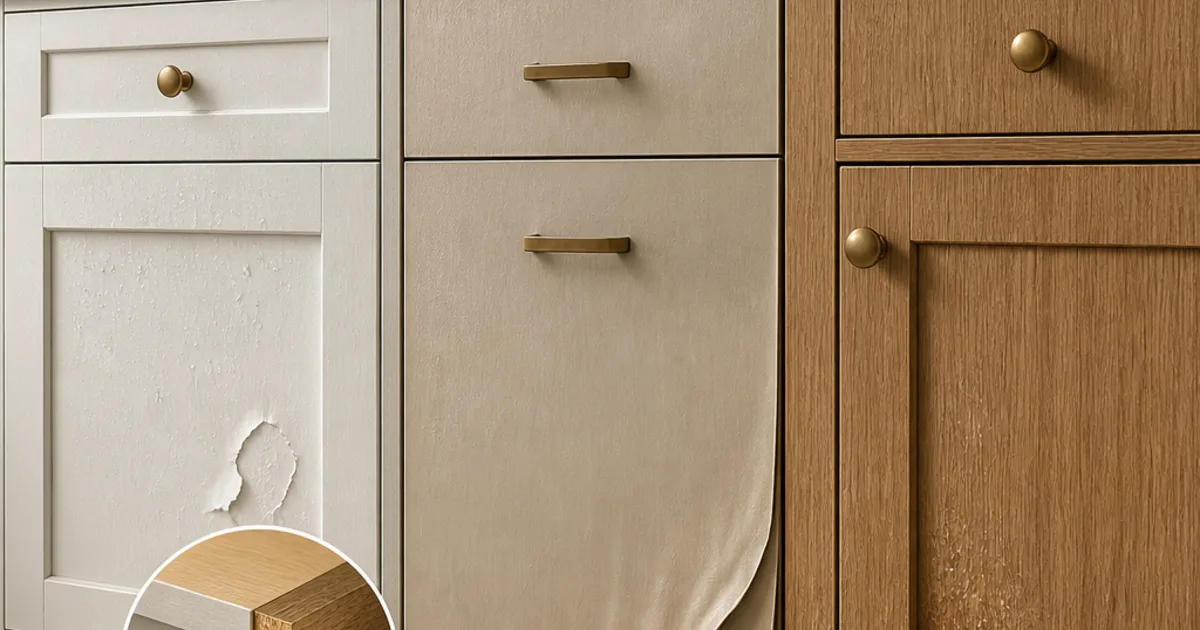
Three finishes. Different strengths.
Use this guide to compare the finish, the cabinet underneath it, and how your bathroom handles moisture.
| Finish | Main advantage | What to watch |
|---|---|---|
| Painted | Color flexibility and touch-up options | Finish quality and exposed edges |
| Thermofoil | Easy-clean, water-shedding face | Heat exposure and lifting seams |
| Wood veneer | Natural grain and furniture-like warmth | Standing water and unsealed edges |
Swipe or scroll to see all three columns →
In a humid bathroom, a factory-finished painted vanity on a stable door core is the most forgiving choice overall, thermofoil is the most water-resistant surface until the edges start to lift, and wood veneer looks the best but demands the most ventilation and care. None of the three fails because of humidity alone — they fail where water sits, where seams meet, and where steam has nowhere to go. If you're planning a bathroom remodeling project, picking the finish is only half the decision; the other half is how the cabinet is built, sealed, and vented behind it.
Why Bathroom Humidity Breaks Cabinet Finishes
The short verdict, before the explanation: for most humid bathrooms, a factory-painted MDF door is the safest all-around pick because it is the only one of the three you can repair; thermofoil wins on pure splash resistance but is unrepairable once an edge lifts; veneer wins on looks and holds up well in a bathroom that is genuinely ventilated and wiped down. Here's why that ranking holds.
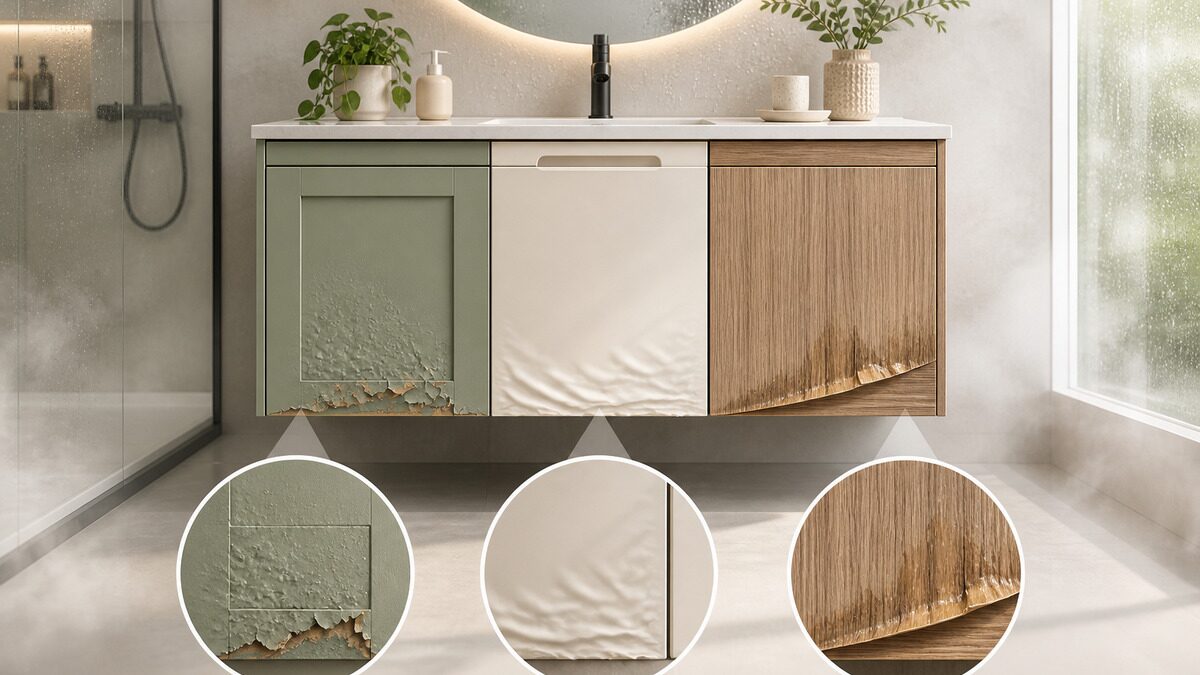
Humidity itself rarely destroys a finish. What destroys it is a repeating cycle: hot steam condenses on cool cabinet surfaces, water runs down to a horizontal edge or an unsealed seam, soaks into the substrate underneath, and the substrate swells. Once a core swells, the finish on top of it has nowhere to go — paint cracks at the joint, thermofoil peels, veneer bubbles.
That means three things matter more than the finish category you choose:
- The substrate. Plywood, furniture-grade MDF, and particleboard respond very differently to absorbed moisture. MDF resists seasonal expansion and contraction better than solid wood (which is why it's common under paint), but it swells badly and permanently if liquid water sits on a raw edge.
- The seams and edges. Toe kicks, the underside of door bottoms, the cut edge where a sink cutout meets the cabinet, and the back panel behind the plumbing are the usual failure points.
- The air. A bathroom with a working exhaust fan vented outdoors — not into the attic — and a habit of running it during and after showers dramatically changes how any of these finishes age.
Painted Finishes: Most Forgiving, Most Repairable
A painted vanity is typically a door made of MDF (often a one-piece or five-piece MDF frame) coated with a conversion varnish, catalyzed lacquer, or similar factory-applied topcoat.
Where it wins: Painted MDF doors have no grain to raise and no wood movement to open up joints. A factory-cured finish is harder and more uniform than anything brushed on site. Color choice is unlimited, and — critically — paint is the only one of the three finishes you can realistically touch up. A chip at the door bottom can be filled, sanded, and spot-coated; a nicked thermofoil edge cannot.
Where it fails: Site-painted or hand-brushed vanities are a different product entirely. Latex wall paint over a poorly primed MDF door will soften, print (leave marks from objects set on it), and lift at edges in a steamy room. Also watch five-piece painted doors made from real wood stiles and rails: the wood moves seasonally, and hairline cracks can appear at the joints. That's a cosmetic characteristic of the construction, not a defect, but it surprises people.
Best for: Most bathrooms, especially kids' baths and guest baths that take hard use and benefit from repairability.
Thermofoil: The Most Water-Shedding Surface — Until an Edge Lifts
Thermofoil is a rigid vinyl film vacuum-pressed over a shaped MDF core, wrapping the face and edges in one continuous skin.
Where it wins: That continuous skin is genuinely waterproof across the face. Splashes wipe off, there's no grain to stain, and the seamless front means no joints for water to creep into. Thermofoil is also easy to clean with a damp cloth — no special wood care products.
Where it fails: Heat and edges. The film is bonded with adhesive, and sustained heat can soften that bond. The classic failure is a thermofoil door directly above or beside a heat source — think a curling iron left on the vanity top, or a built-in cabinet beside a heat register. The back of a thermofoil door is usually a laminated backer sheet, and the seam where face film meets back panel is the weak point. Once the film lifts, there is no repair; the door is replaced.
Best for: Powder rooms, rentals, laundry-adjacent baths, and any space where easy cleaning and budget matter more than depth of finish. Avoid it where a heat appliance will routinely sit on the counter against a door face.
Wood Veneer: Best Looking, Least Tolerant of Neglect
Veneer is a thin slice of real hardwood bonded to a plywood or MDF core, then stained and topcoated. Real wood grain, real figure, and the ability to run grain continuously across drawer fronts is something neither paint nor foil can imitate.
Where it wins: Appearance and feel. Walnut, white oak, and rift-cut veneers are the reason high-end bathrooms and floating vanities read as furniture rather than casework. Because veneer is a thin layer over a stable core, it actually moves less than solid wood slab doors do.
Where it fails: Unsealed cut edges and prolonged standing water. If a veneer door's bottom edge wasn't properly banded and sealed, wicked moisture delaminates the veneer from the core — it bubbles, and sanding it flat removes the veneer itself. Dark stains also telegraph water spots more visibly than paint.
Best for: Primary bathrooms with reliable exhaust ventilation and adults who will wipe up spills. Pair it with a good finish schedule and it can outlast the room's tile.
Color and Design: How Shade Affects Maintenance
Color isn't purely decorative in a wet room — it changes how visible everyday maintenance becomes, and it narrows or widens your finish options.
Dark colors show water, light colors show wear. A black or deep navy blue vanity reads dramatic against white tile, but dried water droplets, toothpaste specks, and dust show clearly on a dark satin topcoat, so plan on wiping more often. Light colors — soft white, greige, pale gray — hide spotting better but reveal chips and scuffs at door bottoms sooner, which is another argument for a repairable painted finish in a busy bath.
Gray and blue behave differently under bathroom lighting. Gray is the most undertone-sensitive neutral: a cool gray can turn blue or violet under certain bulbs, while a warm gray can look beige next to white quartz. Blue vanities, from pale sky to deep navy, usually read more stable but still shift with color temperature. Look at samples under the room's actual fixtures and next to the countertop and tile, not in a showroom.
Finish type limits the palette. Painted doors offer essentially unlimited color, including custom black, gray, and blue. Thermofoil is typically produced in a narrower range — mostly whites, light neutrals, and printed woodgrain patterns — so if a specific saturated color drives the design, paint is the practical route. Veneer gives you wood tone instead of paint color: light white oak for an airy, spa-like design, mid-tone walnut for warmth.
Design details tie it together. A floating vanity with a light wood veneer and a black matte faucet is a different room than a full-height painted base with ornate doors, even at the same price. Match hardware finish, mirror frame, and lighting to the vanity rather than to the tile, and keep door styles simple where humidity is high — flat slab and shaker profiles have fewer horizontal ledges for water to sit on than heavily routed doors.
Details That Protect Any Finish
Once you've narrowed the finish family, the next question is where water and heat actually land on the cabinet.
Storage choices reduce finish damage. Drawer banks instead of open doors keep hairdryers and flat irons inside the cabinet rather than resting hot on the counter against a door — and an in-drawer outlet, where your electrician can run one, removes the heat-near-thermofoil problem almost entirely. A wipeable melamine or finished interior handles the occasional drip better than raw particleboard, and hooks or a towel bar set away from the vanity keep wet textiles off door faces.
Hardware keeps hands off the face. Knobs and pulls keep wet hands and rings off the door face, which is one reason a handle-free, push-to-open front shows wear sooner. Mounting screws through a door face are worth checking too — oversized or over-tightened hardware can stress a thermofoil face at the hole.
Countertops set where the water goes. The countertop material and edge detail decide whether splashes run onto the floor or down the cabinet face. A modest overhang drips water clear of the doors; engineered quartz needs no sealing, while natural stone such as granite or marble is typically sealed periodically. Whatever surface you choose, the sink cutout and the caulk joints are what protect the cabinet below.
Illustrative Example: Three Finishes in the Same House
The following is a hypothetical scenario for comparison, not a customer result.
Imagine one home with three bathrooms, all remodeled at once:
- Primary bath, walnut veneer floating vanity, exhaust fan on a timer, no standing water tolerated. Ten years later it looks like furniture.
- Kids' bath, painted MDF vanity in a light gray. Two chips at the door bottoms from a hamper, both touched up with the leftover factory kit. Still reads as a single consistent color.
- Basement powder room, thermofoil vanity, no window, fan rarely used. The face is spotless, but one door has lifted at the lower corner seam where a towel stayed wet against it, and that door needs to be replaced.
Same humidity, three different outcomes — driven mostly by habits and ventilation, not by which finish was "better."
How to Choose: A Short Decision Path
- Will a heat appliance sit on the counter near a door face? Skip thermofoil there.
- Do you want to be able to repair damage instead of replacing a door? Choose painted.
- Is the exhaust fan undersized, non-existent, or vented into the attic? Fix that before specifying veneer.
- Do you want visible real wood grain? Veneer is the only option of the three that delivers it honestly.
- Is a specific color — black, navy blue, a particular gray — driving the design? Paint is the only finish of the three with an unlimited palette.
- Is the vanity in a windowless room that stays damp for hours? Prioritize a plywood box, sealed edges, and a fan on a timer over any particular door style.
Note that cabinet construction and countertop detailing interact: an undermount sink with a poorly sealed cutout will wet the cabinet from above no matter what the doors are made of. It's worth coordinating your door finish with your countertop service so the sink cutout, caulk line, and backsplash are handled as one waterproof assembly.
Mistakes People Make With Vanity Finishes
- Matching bathroom cabinets to kitchen cabinets by name, not by sample. A "white shaker" from one line and another are rarely the same white. If you're carrying a look from your kitchen into the bath, get physical door samples side by side under the bathroom's lighting.
- Ignoring the toe kick. Water on a tile floor reaches the toe kick first. A finished, sealed toe kick — or a floating vanity with no toe kick at all — removes a common failure point.
- Leaving wet towels hanging on door faces. This is the single most common cause of edge damage across all three finishes.
- Using abrasive or ammonia-based cleaners. They dull painted topcoats, haze thermofoil, and cut through veneer finish. Damp cloth and mild soap is the correct routine for all three.
- Skipping a back panel seal. The cabinet interior behind the trap is where slow supply-line drips go unnoticed for months.
The Practical Next Step
Choosing between painted, thermofoil, and wood veneer is really a choice between repairability, water resistance, and appearance — and the right answer changes per bathroom, not per house. Before you commit, get door samples in hand, look at them under your actual bathroom lighting next to your tile and countertop, and confirm what the box and edge banding are made of, not just what the face looks like. Browsing completed projects helps too, since finishes and colors photograph differently than they look in person. When you're ready to compare bathroom vanity cabinet finishes for your own space, start with the finish and construction details at homescabinet and bring your room's ventilation situation into the conversation — it will shape the recommendation more than you'd expect.
Frequently asked questions
Can I repaint a thermofoil vanity instead of replacing it?
It's possible but unreliable. Paint does not bond well to rigid vinyl without aggressive scuff sanding and a specialty bonding primer, and any area where the film has already lifted will keep lifting under the new paint. If the foil is intact and you accept the risk, it can be a short-term cosmetic fix; if it's peeling, replacing the doors is the better use of money.
Is a plywood cabinet box worth the upgrade over particleboard in a bathroom?
In a bathroom, yes, more than in most rooms. Plywood holds screws better and recovers from incidental moisture far better than particleboard, which swells irreversibly once its edges get wet. The box is also the part you can't easily replace later, so it's the right place to spend.
Does running the exhaust fan really affect cabinet life?
Yes, because it shortens the time condensation sits on cold surfaces. A fan that runs during the shower and for 15–20 minutes after (a timer switch makes this automatic) is the simplest protection for any finish. This is a general building-practice recommendation, not a manufacturer guarantee.
Do dark vanity colors hold up worse in a bathroom?
Not structurally — a black or navy painted door is no more water-sensitive than a white one in the same finish. The difference is visibility: dark satin surfaces show dried water spots, dust, and toothpaste more readily, so they ask for more frequent wiping. Lighter colors hide spotting but show chips at edges more clearly.
What about stained solid wood doors instead of veneer?
Solid wood slab or five-piece doors are a legitimate option, but they expand and contract with humidity swings more than veneer over a stable core. Expect to see seasonal movement at panel edges where unstained wood may peek through. Veneer gives you the same grain with less movement.