
Introduction
When you start shopping for new kitchen cabinets, one of the first decisions you'll face is a term most homeowners have never thought about: inset vs overlay. It sounds like technical jargon, but it describes something you'll see — and live with — every single day. The difference between these two door styles affects how your kitchen looks, how your cabinets function, how much they cost, and even how easy they are to adjust over time. This guide explains exactly what inset and overlay cabinets are, how to tell them apart, and how to decide which is the right choice for your Atlanta home and your budget.
What Are Overlay Cabinets?
Overlay cabinets are the most common cabinet door style in American homes. In an overlay configuration, the door sits in front of the cabinet frame — it overlays, or covers, the face frame rather than sitting inside it.
There are two types of overlay:
Partial Overlay (Standard Overlay): The door covers most of the face frame but leaves a visible gap (usually ½ inch to 1 inch) between adjacent doors and drawers. When you look at the cabinet, you can see the frame around the door. This was the dominant style from the 1970s through the 2000s and is still common in builder-grade and mid-range kitchens.
Full Overlay: The door covers nearly the entire face frame, leaving only a small reveal (typically ⅛ inch) between adjacent doors. When closed, a full overlay kitchen looks clean, seamless, and modern — almost like a slab of cabinetry with minimal frame visible. This is the most popular choice in contemporary and transitional kitchen designs today.
What Are Inset Cabinets?
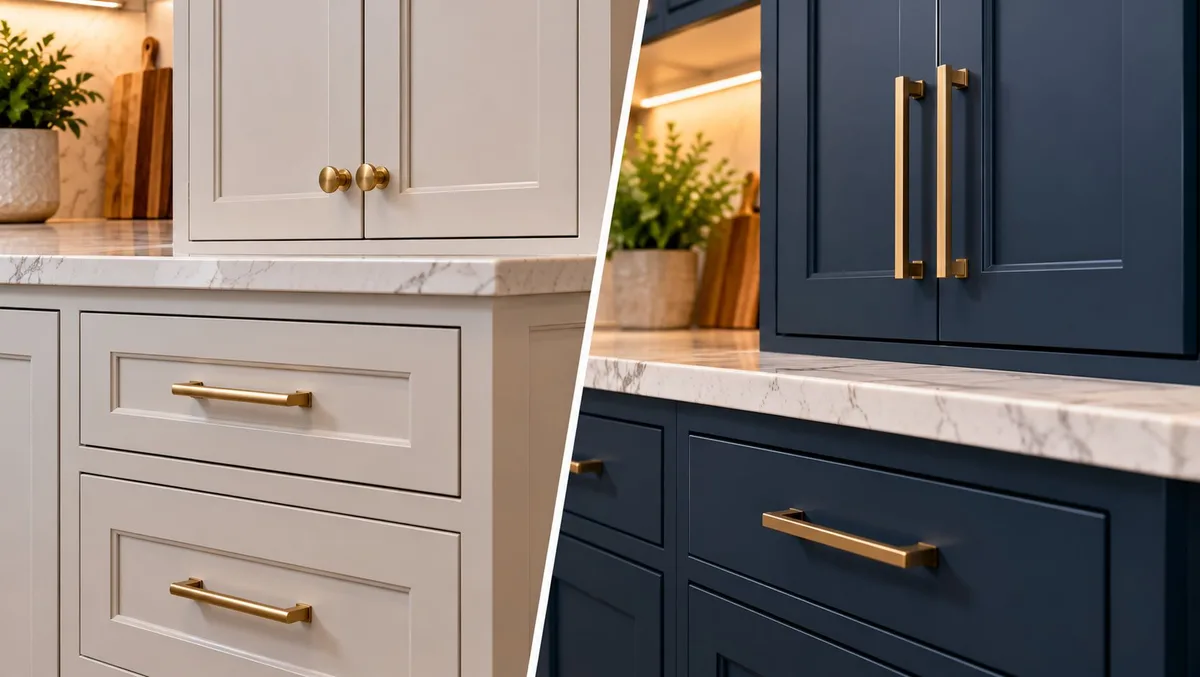
Inset cabinets take the opposite approach: the door sits flush inside the cabinet frame rather than in front of it. When the door is closed, it sits recessed within the opening, with the face frame fully visible around it.
Inset cabinets are considered the most traditional, refined cabinet style. They're commonly found in high-end custom kitchens, period-appropriate renovations (think Federal-style or Georgian homes), and luxury new builds. The look is precise, furniture-like, and unmistakably premium.
Inset doors require tight tolerances — the door must fit perfectly within the opening with a consistent reveal on all four sides. This demands a higher level of craftsmanship and more precise installation.
Inset vs Overlay: Side-by-Side Comparison
Appearance
Partial Overlay: Visible frame between doors. Classic, traditional look. Most common in older Atlanta homes.
Full Overlay: Nearly seamless front. Modern, transitional, or contemporary look. Dominant in new Atlanta kitchen remodels.
Inset: Frame fully visible around flush door. Furniture-like, refined. Associated with high-end traditional or craftsman kitchens.
Cost
Partial overlay is the most affordable option — it's the standard for stock and semi-custom cabinet lines. Full overlay costs slightly more due to larger door sizing. Inset is the most expensive: the precision required adds 15–30% to cabinet cost compared to overlay, and installation takes longer.
Functionality
Overlay cabinets provide slightly more interior storage because the opening is larger relative to the door. Inset cabinets lose a small amount of interior depth at the front edge due to the frame. In practical terms, the difference is minimal — but it's worth noting in very small kitchens.
Hardware
Inset cabinets traditionally require exposed hinges — typically decorative butt hinges that become part of the aesthetic. Overlay cabinets typically use concealed cup hinges (like Blum or Grass) that are invisible when the door is closed. Both look great when properly matched to the kitchen's style.
Adjustment & Maintenance
Overlay cabinets with concealed cup hinges are extremely easy to adjust — you can fine-tune door alignment in seconds with a screwdriver. Inset cabinets are harder to adjust because the fit tolerance is so tight. If your home settles or a hinge wears, an inset door is more likely to stick or gap. This is an important consideration in older Atlanta homes with some structural movement.
Which Style Is Right for Your Atlanta Kitchen?
Choose Full Overlay if:
You want a modern, contemporary, or transitional kitchen look. Full overlay is the default for most Atlanta kitchen remodels today — it's versatile, clean, and works with everything from shaker doors to flat-panel slabs. It's also the most cost-effective way to get a high-end looking kitchen.
Choose Inset if:
You're renovating a traditional, craftsman, or historically styled Atlanta home and want a period-authentic look. Or you're doing a high-end custom kitchen where no-compromise quality and craftsmanship is the priority and budget is not a constraint. Inset is also the right call if you're drawn to furniture-inspired cabinetry where the face frame is part of the design rather than something to hide.
Choose Partial Overlay if:
Budget is a priority and you're replacing worn older cabinets in a rental property, investment property, or a home you plan to sell in the near term. Partial overlay is the most affordable option and is perfectly functional — it just doesn't have the premium look of full overlay or inset.
Cost of Inset vs Overlay Cabinets in Atlanta
Pricing varies significantly by cabinet tier:
Stock overlay cabinets: $80–$200 per linear foot installed. These are pre-built cabinets in standard sizes from big-box stores. Limited configurations, no customization.
Semi-custom full overlay cabinets: $150–$400 per linear foot installed. More size options, finish choices, and interior features. The dominant choice for Atlanta kitchen remodels.
Custom full overlay cabinets: $300–$600+ per linear foot installed. Built to exact specifications, unlimited finish options, highest-quality construction.
Custom inset cabinets: $400–$800+ per linear foot installed. The premium tier. Requires skilled craftsmanship and careful installation. Budget a minimum of $20,000–$50,000 for a full Atlanta kitchen in inset cabinetry.
For most Atlanta homeowners, semi-custom full overlay cabinets deliver the best value — you get a high-end look without the premium price of inset. Talk to a specialist in kitchen cabinets in Atlanta to get an accurate quote for your specific kitchen layout and cabinet preferences.
Inset Cabinets and Older Atlanta Homes: An Important Consideration
Atlanta has a significant stock of older homes — craftsman bungalows, ranch-style homes from the 50s and 60s, and Victorian-era houses in neighborhoods like Grant Park, Candler Park, and Morningside. These homes often appeal to buyers who want period-appropriate renovations.
Inset cabinetry is an excellent choice for these homes — but only if the installation is done correctly. Older homes frequently have floors, walls, and ceilings that are slightly out of square after decades of settling. This creates challenges for inset cabinets, which demand tight tolerances and precise reveals. An experienced Atlanta cabinet installer who has worked in older homes is essential to getting inset cabinets right.
Full Overlay vs Inset: What Resells Better in Atlanta?
Both full overlay and inset cabinets can add value — the difference is your buyer pool. Full overlay cabinets in a contemporary or transitional style appeal to the broadest range of buyers and are the safe choice for resale. Inset cabinets appeal strongly to buyers who specifically want a high-end traditional or craftsman kitchen — a smaller but highly motivated segment.
In high-price-point Atlanta neighborhoods (Buckhead, Brookhaven, Sandy Springs), inset cabinets are increasingly expected in kitchens at the $700k+ home price range. In most other markets, full overlay performs just as well for resale and costs significantly less to execute.
Frequently Asked Questions
Q: What is the most popular cabinet door style in Atlanta kitchens today?
A: Full overlay is by far the most popular choice in Atlanta kitchen remodels for 2026. It delivers a clean, contemporary look that works with traditional, transitional, and modern design aesthetics — and it's more affordable than inset.
Q: Can I mix inset and overlay in the same kitchen?
A: It's not common and generally not recommended. The visual contrast between inset and overlay doors in the same kitchen reads as inconsistent rather than intentional. If you want variation, focus on door style (shaker, flat panel, beadboard) rather than mixing door constructions.
Q: Are inset cabinets worth the extra cost?
A: If craftsmanship, traditional aesthetics, and a furniture-like quality are priorities for you, yes. If you're focused on budget or want a modern look, full overlay delivers excellent results at lower cost. Inset is a premium choice — not a necessary one for most kitchens.
Q: Do inset cabinets stick or warp over time in Atlanta's humid climate?
A: Atlanta's heat and humidity can cause wood to expand and contract seasonally. This is more of an issue with inset cabinets than overlay because the tolerances are so tight — a door that fits perfectly in winter may stick slightly in summer. Quality cabinet manufacturers account for this with their wood drying and finishing processes, but it's worth discussing with your cabinet supplier.
Q: What hinges do inset cabinets use?
A: Traditional inset cabinets use exposed butt hinges — the hinge is visible and becomes part of the aesthetic. Ball-tip butt hinges in brass, nickel, or oil-rubbed bronze are the most common choices. Some modern inset cabinets use concealed European hinges designed for inset installation, but exposed hinges remain the signature look of true inset cabinetry.
Q: How do I know if my existing cabinets are inset or overlay?
A: Open one cabinet door and look at where the door sits relative to the frame. If the door sits flush inside the frame opening (recessed), it's inset. If the door sits in front of the frame and covers it (even partially), it's overlay. Most kitchen cabinets in Atlanta homes are overlay.
Q: Where can I see inset and overlay cabinets in person before I decide?
A: Visit a local Atlanta cabinet showroom where you can see both styles in person and compare them side-by-side. The team at Atlanta kitchen cabinet installation specialists Homes Cabinet can walk you through both options and help you decide based on your home's style, your layout, and your budget.
Planning guidance from Homes Cabinet. Product specifications, site conditions and the agreed scope determine the right solution for your home. Illustrative examples are not project quotations or promises of a particular result.
← Explore more remodeling guides