
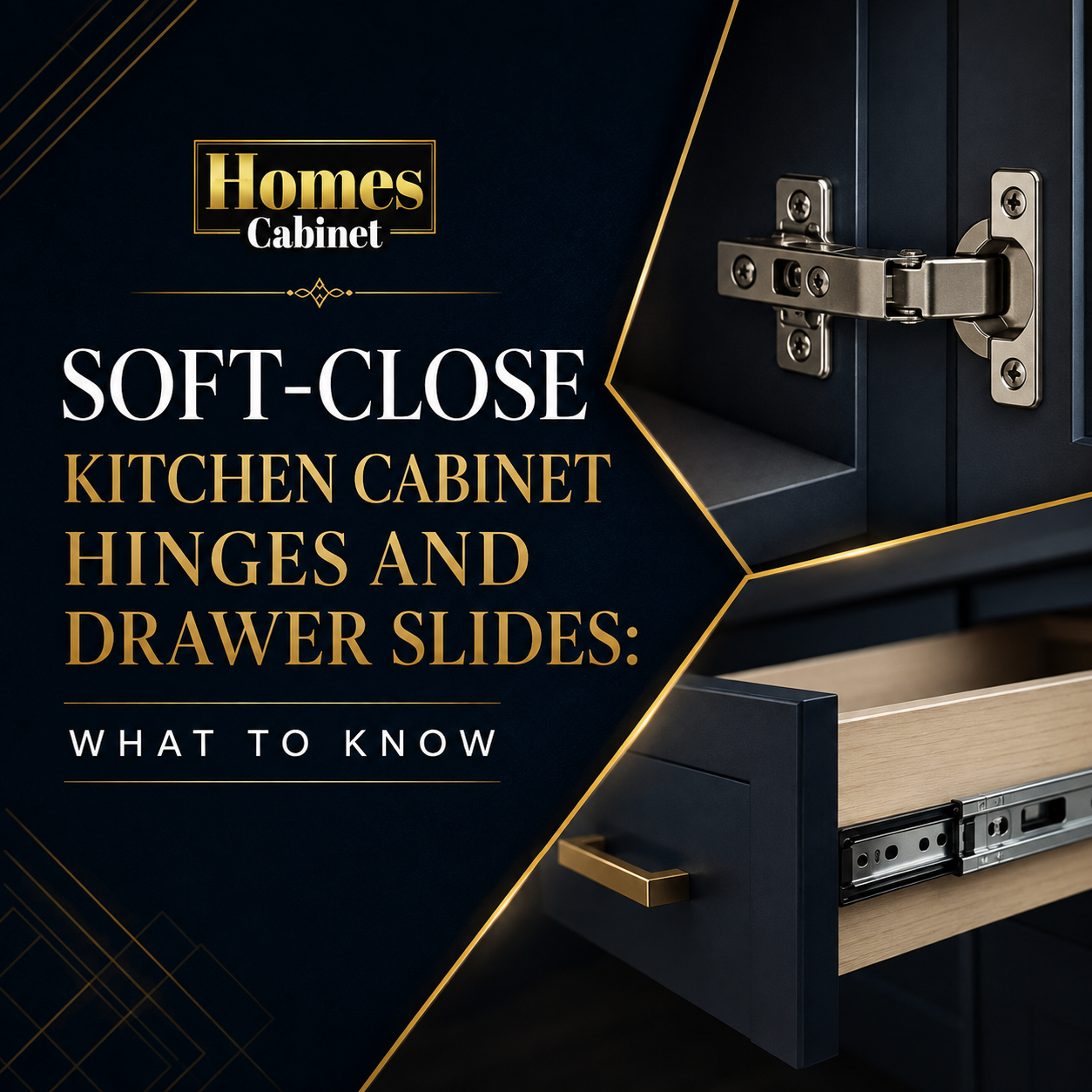
By Homes Cabinet
There is a moment in every kitchen renovation where a homeowner opens and closes a cabinet door or drawer at a showroom and decides they want soft-close hardware in their kitchen. The quiet, controlled finish of a soft-close hinge or drawer slide - that final inch that draws itself closed without slamming - is one of the most tactile quality signals in a kitchen. It is also one of the most practical. This guide covers how soft-close mechanisms work, what separates quality hardware from cheap alternatives, how to specify it in new kitchen cabinets, and how to retrofit it into existing cabinets that do not currently have it.
How Soft-Close Hardware Works
Soft-close hinges and drawer slides use a small hydraulic or pneumatic damper built into the hardware mechanism. When the door or drawer reaches the final inch or two of its closing travel, the damper engages and slows the movement to a controlled, silent stop. The mechanism absorbs the kinetic energy of the closing motion rather than transferring it to the cabinet frame as impact noise and vibration.
In hinges, the damper is typically integrated into the hinge cup itself - the round mounting point that sits in a bore hole in the cabinet door. In drawer slides, the damper is built into the slide mechanism and engages when the drawer reaches the last inch of travel. Both work on the same hydraulic damping principle: fluid resistance slows the final movement to a stop.
The mechanism is passive - it requires no power, no batteries, and no user action beyond closing the door or drawer normally. It engages automatically at the correct point in the closing motion and resets automatically when the door or drawer is opened again.
Soft-Close Hinges: What to Look For
Cup Size and Bore Compatibility
European-style cup hinges - the standard in virtually all modern cabinet installations - require a bore hole in the cabinet door for the hinge cup to sit in. The standard bore size is 35mm, which is compatible with nearly all modern hinges. When retrofitting soft-close hinges to existing cabinets, confirm the existing bore size before ordering replacement hinges. Most existing European cup hinges use 35mm bores, but some older installations use 26mm or other sizes.
Overlay vs Inset Compatibility
Soft-close hinges are manufactured for specific overlay configurations - full overlay, half overlay (partial overlay), and inset. Using the wrong overlay hinge produces doors that do not align correctly. When replacing or retrofitting hinges, match the overlay specification to your existing cabinet door configuration. Full overlay hinges are the most common in contemporary and transitional kitchens; inset hinges require a different cup positioning and are not interchangeable with overlay hinges.
Adjustability
Quality soft-close hinges offer three-way adjustment: height (up/down), lateral (left/right), and depth (in/out). This adjustment range allows doors to be precisely aligned after installation and re-aligned if the house settles or the cabinet shifts slightly over time. Hinges with limited or no adjustability are a false economy - they produce doors that cannot be tuned to hang perfectly and that cannot be re-aligned if needed.
Damper Quality
The damper mechanism in a soft-close hinge is the component most likely to fail over time. Cheap dampers use thin fluid seals that degrade within a few years, allowing the damper to leak and lose its braking effect. Quality dampers from established hardware manufacturers - Blum, Grass, Salice, Hettich - use more robust seals and fluid formulations that maintain consistent damping action for the life of the cabinet. Specifying name-brand hardware from these manufacturers is the most reliable way to ensure the soft-close function remains effective after 10 or 15 years of daily use.
Soft-Close Drawer Slides: What to Look For
Extension Length
Soft-close drawer slides come in full-extension and partial-extension configurations. Full-extension slides allow the drawer to extend 100% out of the cabinet box, making every inch of drawer depth accessible. Partial-extension slides stop at 75% of depth, leaving the back quarter of the drawer inaccessible. Specify full-extension slides for all kitchen drawers - the additional cost over partial-extension is modest and the usability difference is significant, particularly in deeper base cabinet drawers.
Weight Capacity
Kitchen drawer slides must support the weight of the drawer box plus its contents. Base cabinet drawers holding pots, pans, canned goods, or other heavy items need slides rated for 75-100 lbs per drawer. Upper cabinet drawer slides for lighter items can use slides rated for 50 lbs. Specifying slides with adequate weight ratings prevents the premature wear that occurs when slides are used at or above their design capacity.
Side-Mount vs Undermount Slides
Side-mount slides attach to the sides of the drawer box and the interior walls of the cabinet. They are the more common and less expensive configuration. Undermount slides attach to the bottom of the drawer box and are concealed from view when the drawer is open - the drawer appears to float in the cabinet opening. Undermount slides require a specific drawer box construction with a notch for the slide mechanism, and they cost more than side-mount, but they produce a cleaner aesthetic and typically include higher-quality bearing mechanisms.
In 2026, undermount slides are increasingly specified in contemporary and premium transitional kitchens where the clean, hardware-free appearance of the drawer interior is a design priority. Side-mount slides remain the standard in mid-range renovations and perform equally well functionally.
Ball-Bearing vs Roller Mechanism
Ball-bearing drawer slides use steel ball bearings between the slide members to reduce friction and support heavier loads. Roller slides use plastic rollers, which are less durable, have lower weight capacity, and produce a rougher slide action over time as the rollers wear. All quality kitchen drawer slides should use ball-bearing mechanisms. Roller slides belong in light-duty furniture applications, not kitchen cabinets.
Top Hardware Brands: What the Industry Uses
The soft-close hardware market has a clear quality tier structure. At the top are the European hardware manufacturers whose products set the standard:
Blum (Austria): The most widely specified cabinet hardware brand in quality kitchen installations globally. Blum Clip Top hinges and Tandem drawer slides with Blumotion soft-close are the benchmark specifications in premium and custom cabinet installations. Blum hardware is durable, precisely adjustable, and has the most extensive range of configurations for different overlay and application types.
Grass (Austria): A strong Blum competitor with comparable quality. Grass Tiomos hinges and Nova Pro drawer slides are used by many premium cabinet manufacturers as alternatives to Blum. Quality and durability are equivalent.
Salice (Italy): Well-regarded for hinge quality, particularly in inset and special-application configurations. Less widely used than Blum or Grass in the US market but trusted by cabinet shops that specify them.
Hettich (Germany): Another European quality manufacturer with a full range of hinges and slides. Often used in European-made cabinets imported to the US market.
Below these tier-one manufacturers are numerous Asian manufacturers producing soft-close hardware at lower price points. Quality varies significantly and the damper longevity is typically lower than the European brands. For a kitchen renovation intended to last 20 or more years, specifying Blum or Grass hardware is the most reliable choice.
Retrofitting Soft-Close Hardware to Existing Cabinets
If your existing kitchen cabinets do not have soft-close hardware, both hinges and drawer slides can be retrofitted without replacing the cabinet boxes or doors.
Hinge retrofit: Existing European cup hinges can be replaced with soft-close versions as long as the bore size matches (almost always 35mm for modern hinges) and the overlay configuration is the same. The hinge plate that mounts in the cabinet frame may also need to be replaced to match the new hinge. This is a straightforward DIY-accessible project for homeowners comfortable with a screwdriver - each hinge typically takes 5-10 minutes to swap.
Drawer slide retrofit: Replacing drawer slides requires removing each drawer, unscrewing the existing slides from the drawer box and cabinet interior, and installing the new slides in the same positions. The new slides must match the length of the existing slides (measured in inches from front to back of the drawer opening). This is slightly more involved than hinge replacement but remains DIY-accessible for most cabinet types.
Add-on soft-close adapters: For homeowners who want soft-close action without replacing hinges or slides, clip-on soft-close damper adapters are available for some hinge types. These clip onto existing hinges and add a small external damper. They are less elegant than integrated soft-close hinges and add visual bulk to the hinge, but they are the lowest-cost retrofitting approach.
Specifying Soft-Close in New Kitchen Cabinets
When specifying new custom kitchen cabinets or semi-custom cabinets, soft-close hinges and drawer slides should be a standard specification rather than an upgrade. At the premium semi-custom tier and above, most manufacturers include soft-close as standard. At the entry-level semi-custom tier, soft-close may be an add-on. Confirm the hardware specification before ordering - a cabinet quote that does not specify soft-close as standard should be questioned.
Our kitchen remodeling team specifies Blum soft-close hardware as standard on all cabinet installations. We consider it a baseline quality standard, not an upgrade.
Soft-Close Hardware in Atlanta Kitchens
In Atlanta, soft-close hardware has been a standard expectation in kitchen renovations for several years. Homeowners viewing completed kitchens in Decatur, Buckhead, and Alpharetta showrooms consistently cite the soft-close feel as one of the most noticed quality indicators. For kitchen cabinets in Atlanta renovation projects, specifying soft-close on every hinge and every drawer slide - rather than just on some - is the approach that produces the most consistent quality feel throughout the kitchen.
Frequently Asked Questions
Can soft-close hinges be added to any cabinet door?
Yes, in most cases. As long as the cabinet door uses a standard European cup hinge with a 35mm bore, a soft-close replacement hinge can be installed in the same bore. Doors with older non-European hinge types (surface-mount hinges, butt hinges) require a different approach - either a clip-on damper adapter or a full door drilling and re-hinging to accept European cup hinges.
Do soft-close drawer slides wear out?
The damper mechanism in soft-close slides does degrade over time, particularly in high-use drawers. Quality slides from Blum or Grass maintain consistent soft-close action for 10-15 years of daily use. Cheap slides may lose their damping action within 3-5 years. When a soft-close slide loses its damping feel, the entire slide should be replaced rather than attempting to repair the damper.
Are soft-close hinges worth the extra cost on a budget renovation?
Yes. The cost premium for soft-close hinges over standard hinges is approximately $2-$5 per hinge at the material level. For a typical kitchen with 20-30 hinge positions, the total premium is $40-$150 - a negligible amount relative to the total renovation cost. The quality perception and daily-use benefit of soft-close far outweighs this cost difference. Specifying soft-close on a budget renovation is one of the highest-value-per-dollar decisions available.
Upgrade Your Kitchen Cabinet Hardware
Homes Cabinet installs kitchen cabinet installation with Blum soft-close hardware as standard. If you are planning a new kitchen or want to retrofit soft-close into existing cabinets, contact us for a free consultation.
Get Started Today
Ready to Begin
Ready to Begin
Your Project?
Visit either Atlanta showroom, start your free 3D design, or call us — no pressure, just possibilities.