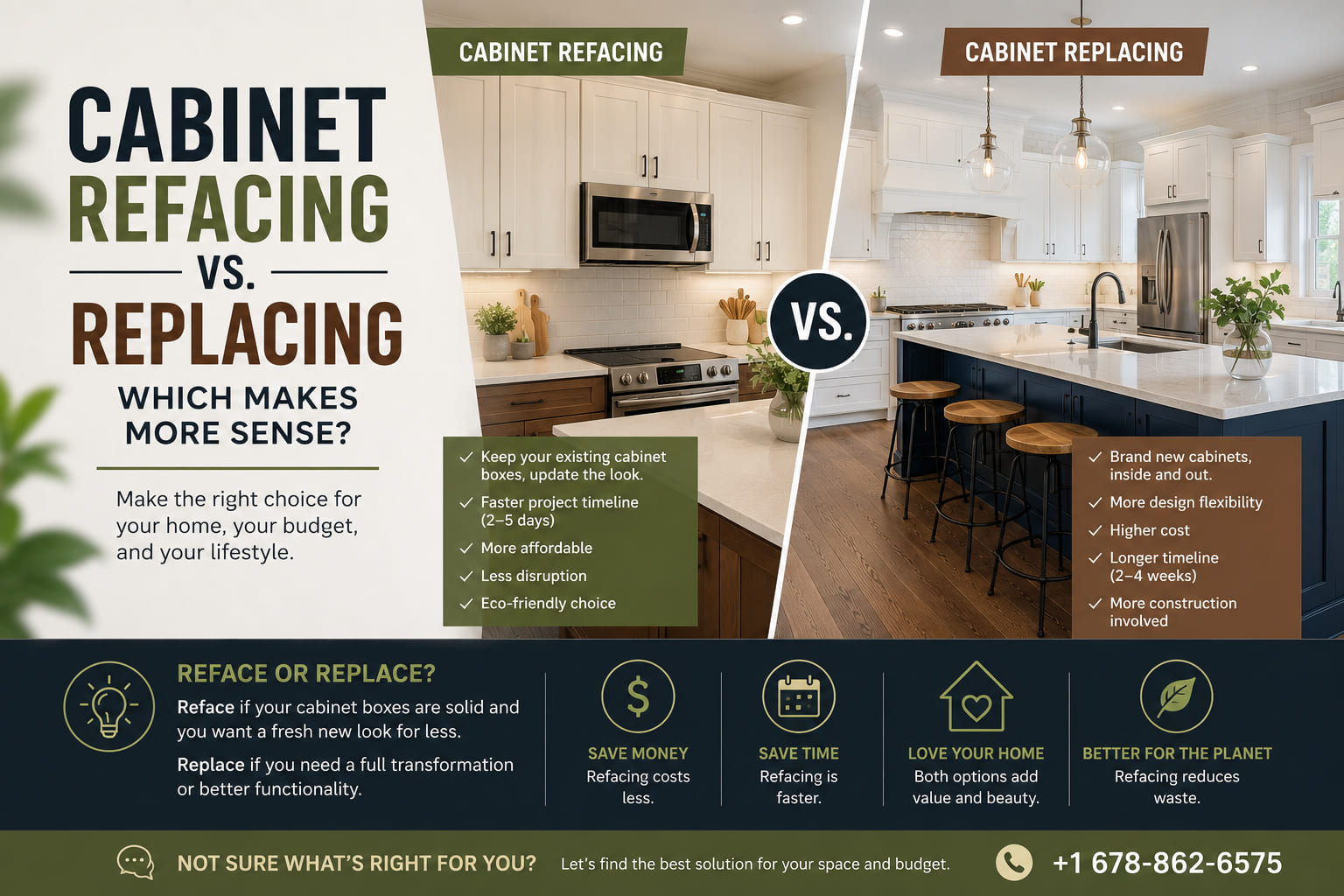
Most homeowners approaching a kitchen update frame the decision wrong from the start. They ask "what style do I want?" before asking "what do I actually need to change?" That sequencing leads to full cabinet replacement budgets for kitchens that only needed new doors.
The refacing vs. replacing question is the right one to start with — and the answer depends on four things: the structural condition of your existing cabinet boxes, whether your current layout functions the way you need it to, the door style you're moving toward, and what your budget can realistically support. Work through those four in order and the decision usually becomes clear.
Refacing leaves your existing cabinet boxes exactly where they are. The doors and drawer fronts are removed and replaced with new ones in your chosen style and finish. A matching veneer — typically a real wood or wood-look laminate — is applied over the exposed face frames of the cabinet boxes so everything reads as a single, consistent surface. Hardware is updated as part of the same scope.
The result is a kitchen that looks like it received a full cabinet replacement. The visual transformation is complete — new door profiles, new finish color, new hardware — but none of the underlying structure changed. The boxes stay. The toe kicks stay. The cabinet positions stay.
That's the operational advantage that most homeowners underestimate. Because the boxes don't move, there is no plumbing rework, no electrical rework, and no appliance disconnection. The kitchen remains livable throughout the refacing process, which typically runs three to five days for a standard-size kitchen. Compare that to a full replacement, which involves demo, rough-in adjustments, installation, and finishing work across two to four weeks.
Refacing is the right move when your kitchen's structure is sound and you want a meaningfully different look without the cost and disruption of starting over.
Yes — and the distinction matters for budgeting.
Refinishing changes only the color or finish on your existing doors. The doors stay in place. A professional sands, primes, and repaints or restains the existing door faces and drawer fronts. No new doors are ordered. No veneer is applied to the box faces.
Refacing replaces the doors and drawer fronts entirely and applies veneer to the box exteriors. It's a more complete transformation and costs more — but it also delivers a more dramatic result and allows you to change the door profile entirely, not just the color.
Replacing removes everything — boxes, doors, hardware — and installs a fully new cabinet system.
Think of it as three levels of intervention, each with a corresponding cost and scope.
Refacing has real limits. There are specific conditions where replacement is the correct call — not because of preference, but because refacing physically cannot solve the underlying problem.
Replace when the cabinet boxes are structurally compromised. Water damage is the most common culprit. If the base cabinets under the sink show swelling, delamination, or soft spots from a slow leak, the box is no longer a sound substrate for refacing. Applying new veneer and doors over a damaged box is a short-term fix that will fail — the moisture problem doesn't stop because the exterior looks new.
Replace when the layout needs to change. Refacing works only within the existing cabinet footprint. If you want to add an island, remove a peninsula, extend a cabinet run into an adjacent wall, or change the height of your upper cabinets, refacing cannot accommodate any of those moves. The boxes have to come out to make structural layout changes.
Replace when the door style you want requires a different box size. Most door style changes are compatible with refacing — you can go from a raised-panel door to a shaker profile on the same box without issue. But if you want to move from standard 30-inch upper cabinets to 42-inch uppers, or from 12-inch deep uppers to 24-inch deep pantry cabinets, refacing isn't the path. New boxes are.
Replace when the boxes are particleboard and water-damaged. Particleboard — the compressed wood fiber panel common in budget stock cabinets — swells when it absorbs moisture and does not return to its original dimension. A particleboard box that has cycled through humidity damage multiple times will have compromised screw-holding capacity, racked corners, and joints that have opened. Veneering over it adds cost without adding stability.
Replace when the existing layout genuinely doesn't work. If you've lived with a kitchen that has a bad traffic flow — a refrigerator door that blocks the prep counter, a corner cabinet that's inaccessible, a dishwasher positioned too far from the sink — refacing preserves all of it. Replacement is the only path to fixing layout-level problems.
Before calling anyone for a quote, walk through this in order:
The cost relationship between the three options — refinishing, refacing, and full replacement — is consistent enough across markets to use as a planning baseline, even before you have real quotes.
Refinishing runs roughly two-thirds the cost of refacing. For a standard kitchen with 10 to 15 linear feet of cabinets, professional refinishing typically falls in the range of $1,500 to $4,000 depending on door count, current finish condition, and labor market.
Refacing runs approximately 70 to 80 percent of what full replacement would cost for the same kitchen. For a 10- to 15-linear-foot kitchen, refacing typically runs $4,000 to $9,000 depending on the door material chosen (thermofoil, wood veneer, or solid wood) and the hardware spec.
Full cabinet replacement for that same kitchen ranges from $8,000 to $20,000+ installed, depending on whether you're sourcing stock, semi-custom, or custom cabinetry — plus the installation labor, countertop removal and replacement if the cabinet height changes, and any incidental plumbing or electrical adjustments.
These are ballpark figures. The actual number on your project depends on your cabinet count, the material tier you choose for new doors or boxes, and what your local labor market looks like. But the ratio holds: refacing is consistently the middle path that delivers a high-impact visual result at a fraction of the full replacement cost.
Within the refacing category, three factors move the number most:
Door material. Thermofoil (vinyl-wrapped MDF) doors are the lowest cost option in refacing and are appropriate for painted finishes. Real wood veneer doors cost more but take stain and hold up better over time at high-contact areas like edges and corners. Solid wood doors are the premium tier and are appropriate when the rest of the kitchen is being specified at a high level.
Door count and drawer front count. The per-unit cost of each new door and drawer front is the primary labor and material driver in a refacing quote. A kitchen with 24 doors and 12 drawer fronts costs more to reface than one with 14 doors and 8 drawer fronts — regardless of the linear footage.
Veneer material for the box faces. The veneer applied to the exposed cabinet frame faces needs to match the new door material. Higher-quality veneer — real wood versus paper-backed laminate — costs more and produces a more durable and visually accurate result.
Q: Is cabinet refacing worth it? For kitchens where the box structure is solid and the layout works, yes — consistently. Refacing delivers a near-complete visual transformation at a cost that's 20 to 30 cents on the dollar compared to full replacement. The disruption is significantly lower, the timeline is shorter, and the result for a well-executed reface is indistinguishable from new cabinets to anyone who wasn't in the kitchen before. The cases where it isn't worth it are specific: damaged boxes, layout changes needed, or a door style that requires a different box size.
Q: How long does cabinet refacing last? A quality reface — hardwood veneer on the box faces, solid wood or quality thermofoil doors, and new soft-close hardware — holds up 15 to 20 years with normal daily use. That matches the service life of many mid-range semi-custom cabinet replacements. The durability ceiling is set by the veneer bond and the door material at high-contact edges. A professionally executed reface with quality materials is not a short-term fix.
Q: Can you reface cabinets yourself? Refinishing — painting your existing cabinet doors — is genuinely DIY-accessible with proper preparation: deglossing, sanding, priming with a bonding primer, and applying a furniture-grade paint in a satin or semi-gloss finish. The preparation work is 80 percent of the result.
Refacing with veneer and new doors is a different scope entirely. Applying veneer to box faces requires precise cutting, clean adhesive application, and accurate seaming at corners and edges. New doors need to be hung with consistent reveals across the full run. Misaligned face frames and inconsistent door gaps are visible from across the room and are the most common result of amateur refacing attempts. For refacing specifically, professional installation produces a meaningfully better outcome.
Q: What's the difference between refacing and refinishing? Refinishing changes only the color or finish on your existing doors — the doors stay in place and are painted or restained. Refacing replaces the doors and drawer fronts with entirely new ones and applies veneer to the exposed cabinet box faces. Refinishing costs less and has a narrower range of outcomes; refacing costs more but allows you to change door profiles, add new hardware, and produce a more complete visual transformation. Both preserve the existing boxes.
Q: Can you reface cabinets if they're particleboard? It depends on the condition of the particleboard. If the particleboard boxes are dry, structurally intact, and showing no water damage or swelling, refacing is physically possible — the veneer will adhere and the new doors will hang. If the particleboard has absorbed moisture and swollen at any point, the structural integrity is compromised and refacing over it is not a sound long-term investment. A professional assessment of the box condition before committing to a refacing scope is the right step.
Q: How do I know if my cabinet boxes are worth keeping? Check four things: look for water damage under the sink and around the dishwasher cutout; pull a drawer box out and examine the corner construction (dovetail joints hold better than stapled corners over time); push on the face frame where it meets the wall — it should feel solid, not flex; and check whether any shelves are sagging under normal load. A box that passes all four checks is worth keeping.
The framework is simple: assess your box condition first, then your layout satisfaction, then your budget. For most homeowners with kitchens built in the last 15 to 20 years — solid plywood or MDF boxes that haven't seen water damage, in a layout that functions reasonably well — refacing with quality materials delivers the best outcome per dollar spent. You get the look of a new kitchen at a fraction of the cost, with the kitchen livable throughout the process.
If the boxes are compromised or the layout genuinely doesn't work, replacement is the correct call — and knowing that before you commit to a refacing quote saves money and frustration.
Homes Cabinet offers consultations to walk through exactly this assessment: box condition, layout evaluation, door style options for both refacing and replacement, and honest cost comparison across both paths. Call us today — (470) 679-1065
May 22,2026