
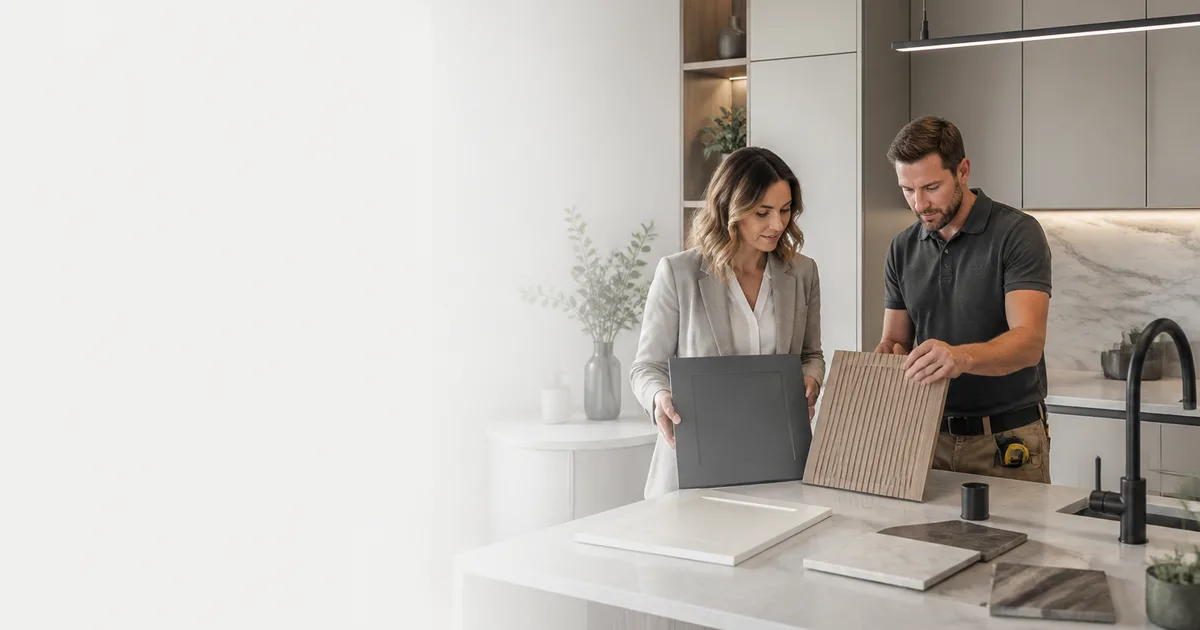
Door style is the single most visible decision in a remodel — it's most of what your eye registers when you walk into a room. Slab, Shaker, and ribbed are the three fronts dominating frameless design right now, and here's the short answer before the detail: flat slab doors and narrow-rail Shaker will still look modern in ten years, while ribbed and fluted fronts only last that long if you confine them to one zone. Before you commit to a full run of kitchen cabinet fronts you'll live with for fifteen years, it's worth understanding why some profiles stay quietly timeless while others start shouting their birth year by about year six.
The Ten-Year Answer, Up Front
As a general rule: slab and narrow-rail Shaker are the two frameless cabinet door styles that still read modern a decade out, because neither leans on a decorative profile that can expire. Ribbed and fluted fronts are the highest-reward option and the highest-risk one — they survive ten years only when they're contained to a single zone, like an island or a bar run. Everything below is the reasoning behind that ranking, plus the variables that actually decide it: rail width, material, price per unit, and how the styles get mixed.
Why Frameless Construction Changes the Door Conversation
Frameless (European-style) cabinets skip the face frame, so doors mount directly to the box. The result is roughly 10–15% more usable interior space per unit, full-overlay doors with tight reveals, and drawers that pull the full width of the opening — which also improves accessibility to whatever's stored at the back.
That construction also changes how a door style reads. On a framed box, a Shaker door sits inside a visible frame and looks traditional. On a frameless box, the same Shaker door becomes a grid of clean rectangles — noticeably more contemporary. So when you're comparing kitchen cabinets online or in a showroom, always confirm which construction you're looking at. The same door photographs completely differently depending on the box behind it. The box and the door are a single visual system, not two separate decisions.
Slab Doors: The Minimalist Benchmark
A slab door is a single flat panel with no profile. It's the default in most high end kitchen projects and the reason European frameless cabinets went mainstream in North America.
What ages well: Slab doors have no decorative language to date. A flat walnut or matte-painted slab from 2015 still looks current in 2025 because there's simply nothing stylistically to expire.
What ages badly: The material, not the shape. High-gloss acrylic slabs, orange-toned builder maple, and ultra-dark espresso thermofoil all read as specific eras. Choose the substrate carefully — rift-cut white oak, matte laminates, and soft neutral paints hold up; trend colors and mirror-finish gloss don't.
Practical note: Slabs show fingerprints and need regular wiping, and they demand near-perfect installation because the long uninterrupted reveals expose any misalignment. They're also the hardest surface to hide seams on, so veneer-matching across a run matters.
Shaker Doors: Safe, But Watch the Rail Width
Shaker is the most-searched door style in the country, and for good reason. The five-piece recessed panel is quietly neutral and works in nearly any house. Most of the slab vs Shaker cabinet doors debate comes down to how much shadow line you want on a long run of fronts.
The risk isn't Shaker itself — it's which Shaker. Wide 2.5" rails with a stepped inner profile read distinctly 2012–2018 builder-grade. Narrow rail Shaker doors (1.5" to 1.75") with a flat, square inner edge read modern and will keep reading modern, especially on a frameless box.
Shaker also holds color better than slab. If you want the crisp navy-and-white or green-and-brass look that dominates preppy kitchen inspiration boards, a narrow-rail Shaker gives the paint somewhere to catch shadow. Just be aware the recessed channel collects dust and cooking film, which matters directly behind a range.
Ribbed and Fluted: The Highest Reward, Highest Risk
Ribbed and fluted cabinet fronts — along with reeded variations — are the fastest-growing detail in cabinetry, and they're genuinely beautiful: vertical texture that catches raking light and adds depth without adding color.
They're also the most likely of the three to date. Heavy texture is always a trend marker. The strategy that protects you is restraint by zone: use ribbed fronts on the kitchen island base, a bar run, a hood surround, or a pantry wall, and keep the perimeter runs slab or narrow Shaker. This does two things — it makes the texture intentional rather than overwhelming, and it means a future refresh only touches a fraction of your doors instead of all of them. Used this way, a ribbed run also works as a visual separator between the kitchen and an open living area. Treated that way, texture becomes a kitchen island cabinet design decision rather than a whole-kitchen gamble.
The same logic applies to bathroom cabinets, where a single fluted vanity reads as a design moment rather than a whole-house commitment.
Mixing Styles Without Creating a Mess
Two door styles in one room is fine. Three is usually a mistake. If you're mixing, hold two variables constant:
- Reveal width. Keep the gap between doors identical across every style so the eye reads one system.
- Hardware logic. Either everything gets pulls or the ribbed sections go handleless with integrated edge pulls. Don't split the difference randomly. One accessibility caveat: integrated edge pulls look clean but are harder to operate with limited hand strength, so D-pulls or long bar pulls are the safer choice in a household that needs them.
This is also where your kitchen backsplash decision matters more than people expect. Textured doors plus a textured tile — zellige, handmade subway, stacked stone — creates visual noise. Pair ribbed fronts with a quiet slab backsplash, and save the character tile for a slab-door kitchen that needs it.
Budget Reality: RTA, Semi-Custom, and Full Custom
RTA cabinets have improved a lot, and they're a legitimate option for slab and standard Shaker in common sizes. Where they fall short is narrow-rail Shaker, true ribbed fronts, and non-standard island dimensions — those almost always require semi-custom or custom milling. Check any RTA delivery against the packing list, too: a missing filler strip or toe-kick piece can stall an install for a week.
If you're pricing a kitchen remodel and searching "kitchen remodel near me" or "kitchen renovation near me," get at least one quote that breaks out door style as a line item, with a price per unit rather than a lump sum. You'll often find that upgrading only the island to a textured front costs less than you assumed, while upgrading every door costs more.
Conclusion
Flat slab doors and narrow-rail Shaker (1.5"–1.75" with a square inner edge) are the two frameless cabinet door styles that still read modern ten years out, because neither relies on a decorative profile that can expire — with those, only material and color date, and both are replaceable.