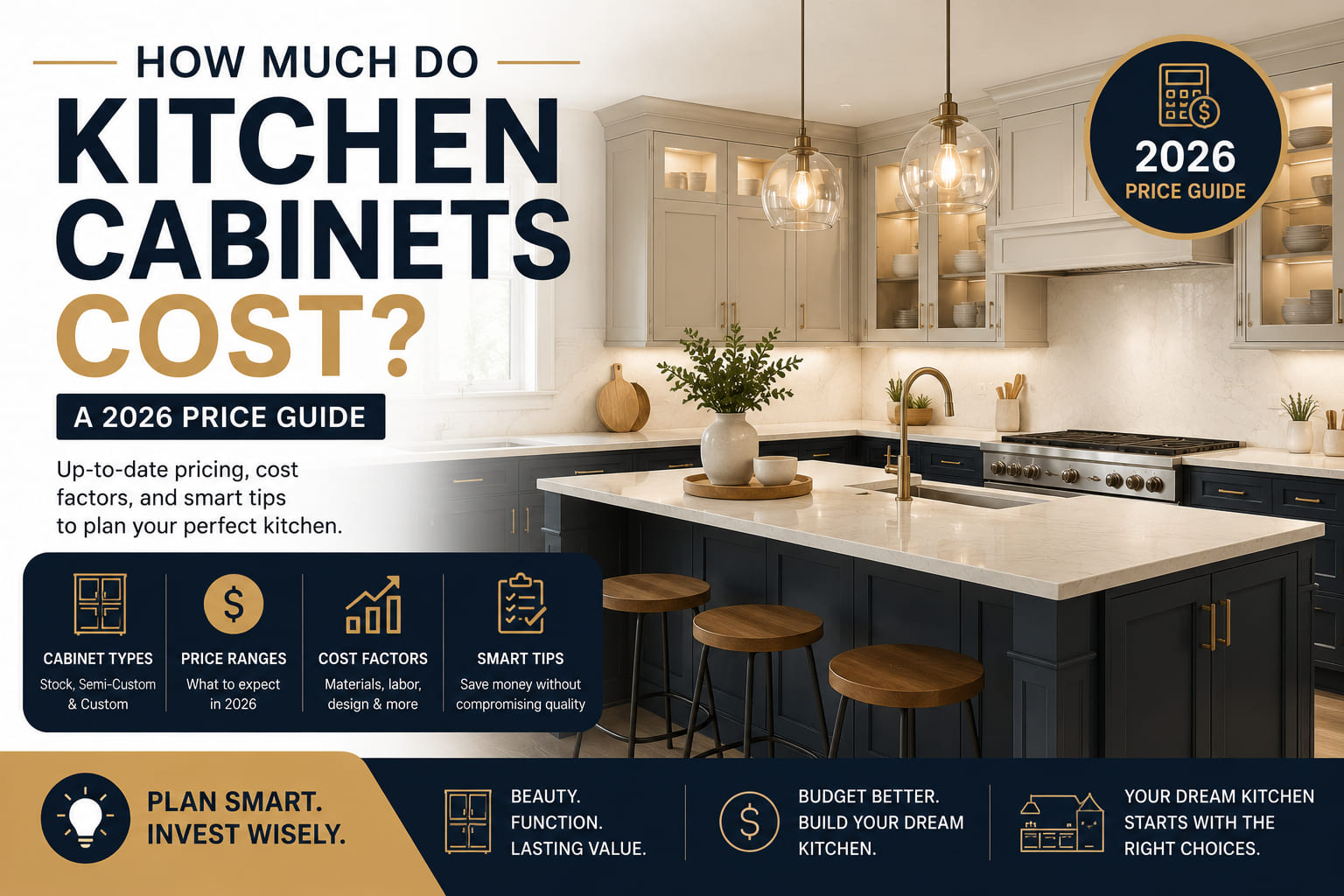
Cabinet pricing is the part of a kitchen remodel that surprises people the most — not because the numbers are hard to find, but because the range is so wide that a single figure is almost meaningless. A homeowner who asks "how much do kitchen cabinets cost?" can get an honest answer of $3,000 or $60,000 for the same square footage of kitchen, depending entirely on the choices made.
This guide breaks the price range into useful layers. Rather than giving you a single average that describes no one's project, it walks through each decision point — cabinet type, box construction, door profile, wood species, hardware, and installation — and shows you what each one actually costs and why.
Whether you're planning a full renovation, replacing worn-out doors, or starting from a completely raw kitchen, these numbers will give you a working budget before you set foot in a kitchen cabinet store.
Kitchen cabinets are sold in three distinct tiers. Understanding the difference between them is the single most important thing you can do before beginning a budget conversation.
Stock cabinets are pre-built in fixed dimensions — typically in 3-inch width increments — and held in warehouse inventory. What you see in the box-store aisle is what ships. Lead times are fast, often one to two weeks, and the price is the lowest available in the market.
The tradeoff is inflexibility. Stock cabinets come in a limited range of door styles (predominantly shaker), a narrow finish palette, and standard box depths. If your kitchen has unusual dimensions, an angled wall, or architectural features that require a non-standard size, you'll fill the gaps with filler strips — a workable solution but not a precise fit.
Box construction on stock cabinets is almost universally MDF or particleboard with a thermofoil or vinyl-wrap finish on the doors. This is adequate for dry climates but less durable in high-humidity environments. Drawer slides are typically side-mount metal glides rather than full-extension undermount hardware.
For a 10-foot by 10-foot kitchen — the industry-standard pricing benchmark using 20 linear feet of cabinet — stock cabinets run roughly $1,600 to $6,000 installed, before countertops and hardware.
Semi-custom cabinets are built to order within a manufacturer's set of available options. You choose the door style, wood species, finish color, interior fittings, and box specifications from a defined menu. Sizes are available in smaller increments — typically 1.5 inches — which produces a much tighter fit in non-standard kitchens.
This is the category that most homeowners working with a kitchen cabinet store will land in. Semi-custom lines give you meaningful control over how the cabinets are built without the lead time and cost of full custom work. Box construction in mid-to-upper semi-custom lines is typically ¾-inch plywood with dovetail drawer boxes and soft-close hinges as standard.
Lead times run 3 to 10 weeks depending on the manufacturer and the complexity of the order.
For the same 10x10 benchmark kitchen, semi-custom cabinets installed range from roughly $3,000 to $13,000.
Custom cabinets are built from scratch by a cabinetmaker or millwork shop to your exact specifications. There are no catalog constraints on size, proportion, interior configuration, or material. If you want inset doors with a 3/16-inch reveal on a 42-inch tall upper cabinet in quarter-sawn white oak with hand-forged iron hardware, that's a custom order.
The premium reflects real costs: skilled labor, longer build times, and materials sourced specifically for the project. Lead times typically run 8 to 16 weeks. Installation is more involved because each piece is built to fit its exact location rather than shimmed and trimmed to approximate fit.
Custom cabinets are appropriate when the kitchen has architectural constraints that standard sizing can't address, when the design intent requires period accuracy (such as inset construction for a historic renovation), or when the homeowner simply wants the highest-quality build available.
For the 10x10 benchmark, full custom cabinets can range from $10,000 to $24,000+ installed, and considerably more in high-cost markets.
Two kitchens with identical square footage can have very different cabinet costs even within the same tier. Here's what actually moves the number.
The cabinet box — the shell that sits against your wall — is the most structurally significant cost driver. Three materials dominate:
Plywood is the benchmark for quality box construction. It's cross-laminated, which gives it dimensional stability across humidity swings. Fasteners hold well in plywood because the layers provide real material to grip. Dado-routed shelf pins, dovetail drawer boxes, and hinge mounts all perform better in plywood than in engineered panel products. Plywood adds roughly 15 to 25 percent to the box cost compared to MDF alternatives — a premium that is consistently worth paying in kitchens that see daily use.
MDF (medium-density fiberboard) is smooth, machines cleanly, and paints without telegraphing grain. It's appropriate for painted door panels and face-frame components where dimensional stability is less critical. As a box substrate in climates with significant humidity variation, it has a well-documented weakness: it swells with moisture absorption and doesn't fully return to its original dimension. Over years of seasonal cycling, MDF box cabinets can develop gaps at face-frame joints and racked doors.
Particleboard is the lowest cost option and the least durable. It's common in entry-level stock cabinets and budget import lines. Screws pull out easily, edges chip when struck, and it's highly sensitive to water. If you're shopping on price and see particleboard boxes, factor in a shorter service life.
The door is the most visible component and has a significant effect on price. Here's how the major profiles compare:
Wood species affects both material cost and how the cabinet ages. The major options and their relative pricing:
| Species | Relative Cost | Notes |
|---|---|---|
| Poplar (painted) | $ | Fine grain, paints well, minor color bleed risk |
| Maple | $$ | Hard, tight grain, excellent for painted or light stain |
| Red oak | $$ | Open grain, takes stain with visible variation, durable |
| White oak | $$$ | Tighter grain than red, more stable, premium finish options |
| Quarter-sawn oak | $$$$ | Ray-fleck figure, highly stable, period-appropriate |
| Cherry | $$$ | Deepens with age, elegant, premium pricing |
| Walnut | $$$$ | Dark, richly figured, highest cost domestic species |
| Hickory | $$ | High character grain, cost-effective, rustic reads |
For painted cabinets, maple is the most practical choice at a reasonable price point. For stained work, the species choice is an aesthetic and budget decision made in concert.
Pull-out shelves, lazy Susans, roll-out trash inserts, spice pull-outs, and drawer organizers each add between $50 and $400 per unit to the cabinet cost. These are typically priced as add-ons in semi-custom ordering and as labor-plus-material in custom work.
Dovetail drawer boxes — the interlocking joinery at the drawer corners — add roughly $20 to $60 per drawer over stapled alternatives but significantly outlast them in daily use.
Soft-close hinges and drawer slides are standard on mid-to-upper semi-custom lines and all custom work. On budget stock lines they're either unavailable or an upcharge. The mechanism eliminates door slam, reduces wear at the hinge cup and box mounting point, and adds years of reliable operation. Always worth including.
Cabinet installation is typically priced separately from the cabinet order and runs $50 to $150 per linear foot in most U.S. markets, depending on:
A rough installation estimate for a 20-linear-foot kitchen with standard layout and no structural complications runs $1,000 to $3,000. Complex layouts with islands, specialty corners, or built-in appliance panels run higher.
A full kitchen remodel covers more than just the cabinets. Here's how the budget typically allocates across trades in a mid-range renovation in 2026:
| Component | Typical Range (Full Kitchen) |
|---|---|
| Cabinets (semi-custom, 20 LF) | $6,000 – $13,000 |
| Installation labor | $1,500 – $3,500 |
| Countertops | $2,000 – $8,000 |
| Backsplash tile + labor | $800 – $3,000 |
| Plumbing (sink, faucet, disposal) | $500 – $2,500 |
| Lighting (under-cabinet + overhead) | $500 – $2,000 |
| Flooring (if replaced) | $1,500 – $5,000 |
| Hardware (pulls, knobs) | $200 – $1,200 |
| Total mid-range | $13,000 – $38,000 |
Cabinets typically represent 35 to 45 percent of total kitchen remodel spend. It's the single largest line item in most projects, which is why getting the cabinet budget right before any other decision is the correct sequencing.
The honest answer is that this isn't purely a budget question — it's a durability and fit question as well.
Choose stock cabinets if: Your kitchen has standard dimensions, you're working on a tight timeline (such as a rental property or a flip), and the long-term durability requirement is moderate. Replacing stock cabinets in 10 to 12 years is a realistic scenario with heavy daily use.
Choose semi-custom cabinets if: You want a kitchen that fits your specific layout without filler strips, you care about box construction quality, and you plan to stay in the house for more than five years. Semi-custom is where the best value-to-quality ratio exists in the current market. Most reputable kitchen cabinet stores carry two or three semi-custom lines covering different price points within the tier.
Choose custom cabinets if: The architectural requirements can't be met with semi-custom sizing, you're doing a period-sensitive renovation that requires specific construction methods like inset doors and exposed hinges, or the kitchen is central to the home's long-term value and you want a build that lasts 30-plus years.
Before you request a quote from any kitchen cabinet store near you, these are the questions worth having answered in person:
1. Is the box plywood or MDF? Get a direct answer. Some lines advertise plywood construction as a premium upgrade rather than standard — that's worth knowing before comparing quotes.
2. Are drawer boxes dovetailed? On quality semi-custom lines, this is standard. On entry-level lines, it's either unavailable or a significant upcharge. A quick look at the display sample will confirm it.
3. What is the hinge specification? Soft-close concealed hinges (Blum and Grass are the dominant OEM suppliers) should be standard. If the display cabinets slam when you close them, that's the product you're buying.
4. What are the lead times right now? Supply chain conditions in the cabinet industry have stabilized since the post-pandemic disruptions of 2021–2023, but individual lines vary. Semi-custom lead times of 4 to 8 weeks are normal. Get a current answer, not a historical average.
5. Is installation included in the quote, or priced separately? Always clarify scope. A quote that includes cabinets, delivery, and installation is a different number than one that's cabinets only.
6. What does the warranty cover? Most quality semi-custom lines carry a limited lifetime warranty on box construction and a 5-year warranty on hardware. Get the specific terms in writing.
Q: How much does a 10x10 kitchen cabinet remodel cost in 2026? The 10x10 benchmark — 20 linear feet of upper and lower cabinets in an L-shaped layout — costs roughly $2,000 to $5,500 for stock cabinets, $4,000 to $13,000 for semi-custom, and $10,000 to $24,000+ for custom, not including countertops, installation, or hardware. These figures are for the cabinet product only; add 20 to 30 percent for installation labor in most U.S. markets.
Q: Is it cheaper to reface cabinets or replace them? Cabinet refacing — replacing the door faces and drawer fronts while keeping the existing box — costs roughly 40 to 60 percent of full replacement and makes sense when the existing boxes are plywood, structurally sound, and laid out correctly. If the box is particleboard with water damage, the layout doesn't function well, or the interior hardware is worn, replacement delivers better long-term value.
Q: What is the most durable kitchen cabinet for the money? Plywood box construction with dovetail drawer boxes, soft-close undermount drawer slides, and solid wood face frames. Door material is secondary to box quality in terms of long-term durability. A mid-range semi-custom line built to this spec will consistently outlast a premium-priced stock line built on particleboard.
Q: How long do kitchen cabinets last? Quality semi-custom and custom cabinets with plywood box construction, properly installed and maintained, routinely last 20 to 30 years. Stock cabinets with MDF or particleboard boxes typically show meaningful wear — door rack, drawer face gap, hinge failure — within 10 to 15 years of heavy daily use. The difference is almost entirely in box material and hardware specification.
Q: Do kitchen cabinets add value to a home? Yes — kitchen renovations consistently rank among the highest return-on-investment home improvements. The exact return varies by market and project scope, but a mid-range kitchen remodel (which cabinets dominate by cost) typically returns 60 to 80 percent of the investment in resale value according to industry cost-vs-value analysis. In high-demand markets, the return can exceed 100 percent on well-executed projects.
Q: How do I find a kitchen cabinet store near me that carries quality semi-custom lines? Look for showrooms with display kitchens rather than just sample doors — you want to see the box construction, open drawers, and operate the hardware in person. Ask directly whether they carry plywood-box lines and request to see the drawer box construction on any sample you're considering. A showroom that only carries stock programs with limited door options is unlikely to meet the needs of a renovation requiring specific proportions or period-appropriate construction.
The cabinet market in 2026 has more options at more price points than any previous era of kitchen design. That's genuinely useful — it means there's a workable product at every budget. The challenge is knowing which compromises are structural (and will cost you more down the road) versus which are cosmetic (and don't affect performance or longevity).
Box construction and hardware specification are the two areas where spending up pays the clearest dividend. Door style and wood species are aesthetic decisions that don't materially affect how long the cabinet performs. If the budget requires a trade-off, protect the box and hardware spec before protecting the door profile.
When you're ready to move from research to real numbers, seeing physical samples — pulling a drawer, operating a hinge, looking at the corner construction on a box — is the step that makes the price comparison honest. Homes Cabinet carries a range of semi-custom and custom lines across the construction tiers covered in this guide, so you can evaluate the actual product rather than a specification sheet before committing to a budget.
May 15,2026