
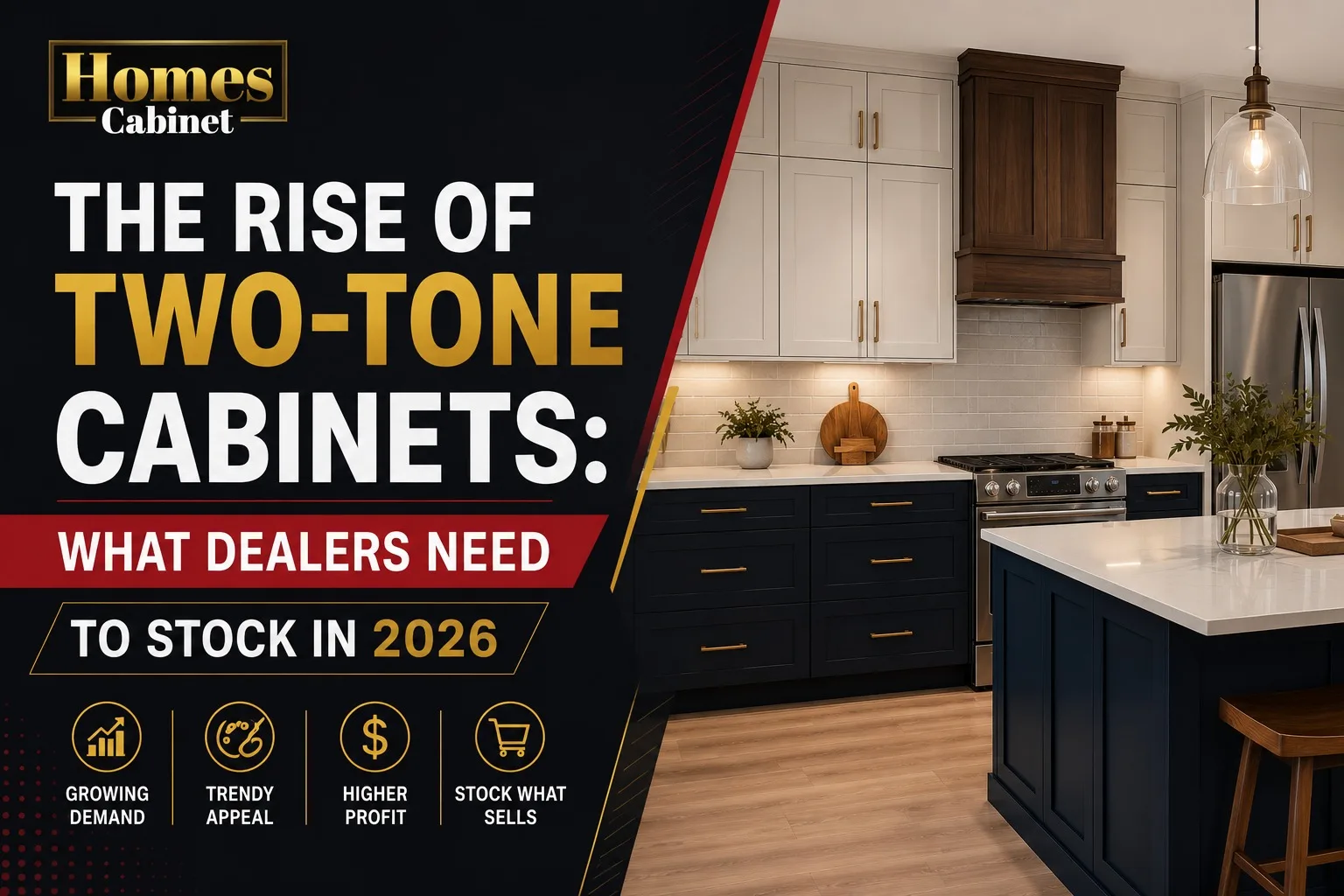
Two-tone cabinetry works best when the second color has a job. It might define an island, make a tall storage wall feel quieter or connect the kitchen to an adjoining room. This updated guide is for homeowners choosing a palette, rather than dealers deciding what to stock.
Choose the purpose of the contrast
Start with the feature you want people to notice. An island can carry a stronger color while the perimeter stays calmer. Different upper and lower finishes can change the visual weight of a wall. A wood accent may connect cabinets with nearby furniture or flooring.
Choose one main idea before combining several. A second color does not have to appear in equal quantities, and every cabinet section does not need its own treatment.
Work from the fixed finishes
Lay cabinet samples beside the countertop, backsplash and floor. If those surfaces are already patterned or high contrast, quieter cabinets may give the room more coherence. If the surrounding palette is restrained, an accent finish can do more of the visual work.
Test undertones in the actual kitchen. Two finishes that look compatible online can behave differently under daylight and artificial lighting. Ask for full-size samples where practical, especially for a large island.
Check what changes between the two selections
- Confirm whether both finishes are available in the required cabinet sizes.
- Compare door profiles, sheen and exposed-end treatments.
- Ask whether trim and panels can be supplied consistently.
- Check lead times for each selected line or finish.
- Keep the exact color assignments on the approved cabinet plan.
Mixing cabinet lines can introduce differences beyond color. Verify construction, dimensions and hardware rather than assuming that two doors with similar names belong to the same system.
Use hardware and lighting to connect the room
A consistent handle family or a deliberate metal finish can tie contrasting cabinets together. Consider nearby lighting, faucets and appliances without assuming every metal must match. Test handle placement and grip on both door finishes.
See our two-tone inspiration guide for additional combinations, then bring a shortlist to a consultation. Decide from a coordinated sample set, not a claim that a particular pairing is guaranteed to be fashionable or increase resale value.
Frequently asked questions
Should the darker color always go on the bottom?
No. That is one approach, not a requirement. Judge the room’s light, cabinet proportions and the focal point you want to create.
Can I add a contrasting island to existing cabinets?
It may be possible. Check the available space, existing finishes, service needs and product compatibility before treating it as a simple color update.
Planning guidance from Homes Cabinet. Product specifications, site conditions and the agreed scope determine the right solution for your home. Illustrative examples are not project quotations or promises of a particular result.
← Explore more remodeling guides